Tertiary education
Academic and professional staff agreements, workload provisions, fixed-term rules, allowances and approval workflows.
 Request demo
Precision AI for regulatory compliance
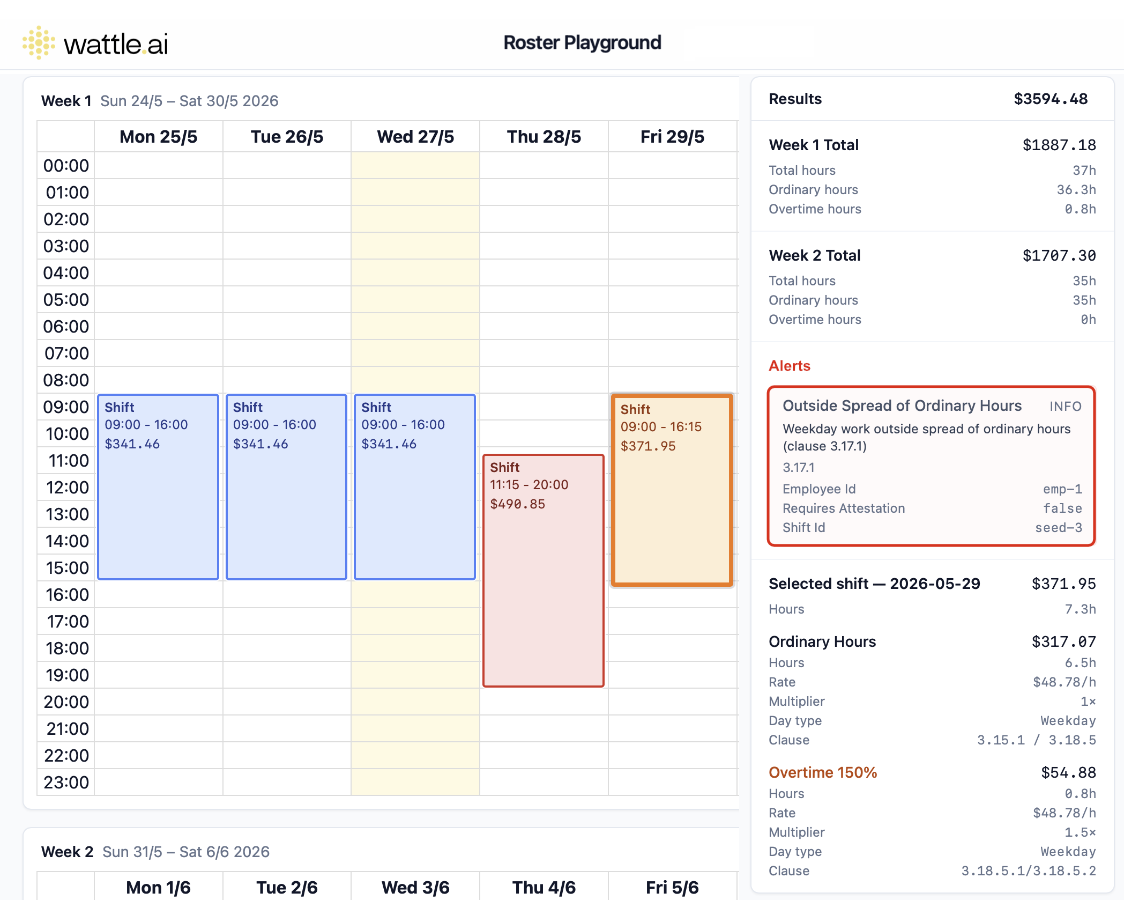
Wattle AI checks rosters, timesheets and payroll events against the full agreements and awards in real-time before errors become underpayments, excessive overtime, disputes or remediation projects.
Across regulated industries
Complex enterprise agreements and awards result in problems that are common across many sectors. Wattle AI addresses these challenges comprehensively.
Academic and professional staff agreements, workload provisions, fixed-term rules, allowances and approval workflows.
Public and private medical workforce agreements, with shift penalties, leave, attestation and roster-change controls.
Retail, aged care, hospitality, transport and public sector — any agreement complex enough that errors only surface at payroll.
The operating problem
Many enterprise agreements and awards have so many interacting rules — overtime, penalties, breaks, allowances, complex time calculations, and local interpretations — that standard payroll and rostering systems cannot encode them accurately, and some are not implemented at all in practice.
How Wattle works
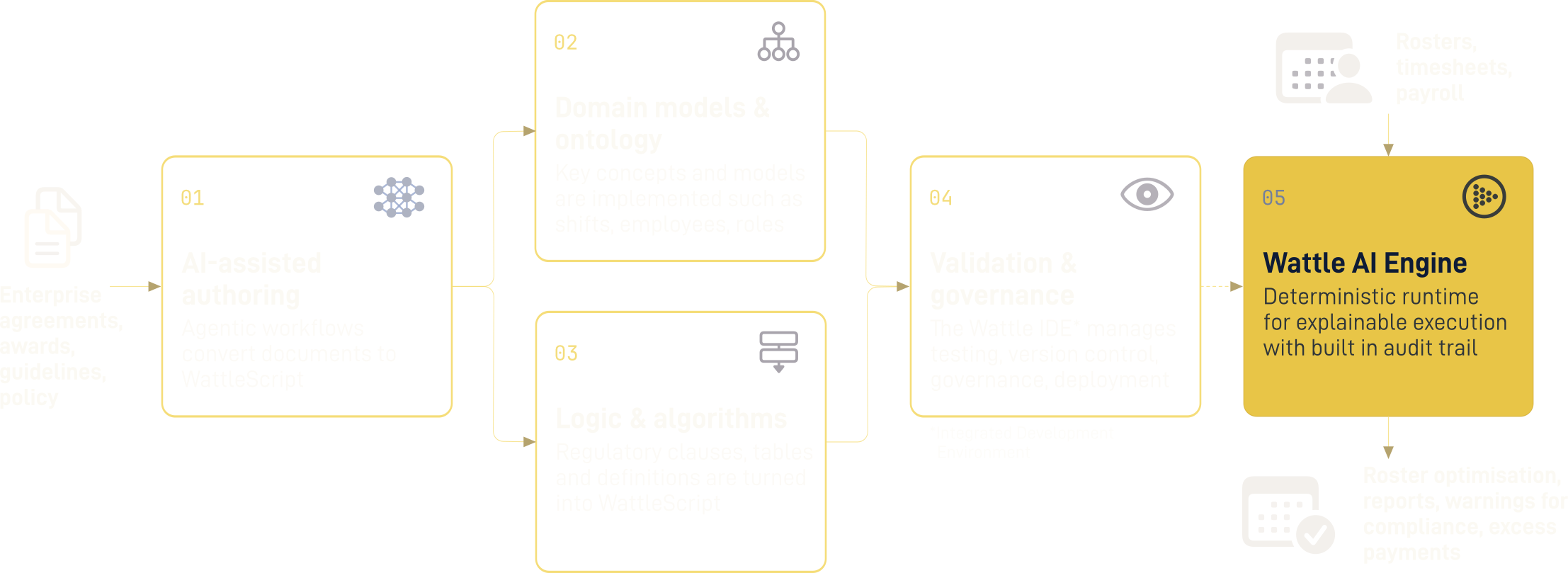
The Wattle AI Engine is built from the ground up for AI authoring, validation, audit and governance. WattleScript, its language, is modern, designed for decision-making and data processing. The result is executable content that runs on a deterministic runtime — tested, versioned, audited and deployed at low compute cost.
Why not prompt-only AI?
| Requirement | Prompt-only generative AI | Wattle AI Engine |
|---|---|---|
| Repeatable decisions | Same prompt and context can still produce different outputs. | Same inputs produce the same verified outputs. |
| Reliability | Hallucinations are inherent in generative AI. Outputs can vary with model, prompt and context length. | Runtime logic is checked and deterministic. |
| Explainability | Generated explanations synthesised and may not reflect how decisions are made. | Outputs link to source clauses, detailed logic traces, tests and release history. |
| Production cost | High compute cost for every operational decision. | Low-cost runtime designed for high-volume event processing. |
| Governance | Prompts and guardrails need rework as models change and cannot be guaranteed. | Versioning, quality gates, governance workflows, monitoring and audit are built in. |
Customer approach
Wattle AI can implement the target agreement before the first formal customer meeting. That changes the conversation from services risk to evidence: the customer can see their own rules running against realistic roster, timesheet and payroll scenarios.
Provide the agreement, award, policy material and representative data shape.
Wattle converts clauses, definitions and tables into domain models and WattleScript.
Demonstrate compliance checks, optimisation opportunities and audit trails before rollout.
Built for governed automation
Wattle checks the rules for errors and confirms every case is covered before they go live — catching problems in development, not production.
Every result links back to the clause it came from, along with the code, tests and outputs behind it.
Testing, release management and versioning are part of the authoring lifecycle.
Runs fast enough to check rosters, timesheets and payroll as they change, even at high volume.
Incoming data can be mapped, validated, warned or rejected before decisions run.
Warnings, tags, calculations, timers, reports and APIs feed the systems already in use.
Team
Founder & CEO
Entrepreneur, Adjunct Professor in Clinical AI (University of Sydney), MBBS and PhD (Stanford), co-founder of Alcidion Group (ASX).
MBBS · PhD · FAIDH
GM – Customer Solutions
Strategic health management consultant and former Director of the Murrumbidgee Transformation Team, leading clinical analytics, activity-based funding and risk stratification.
B.Bus · NSW Premier's Award for Public Service
GM – Commercial
20+ years as a management consultant across healthcare, life sciences, insurance, finance and mining; former GM Pathology Collections & CPO at Healius, and founder of Remedy Healthcare.
BAppSc · MBA
Request a demo
Send us an enterprise agreement, award or policy. A public link is enough to start — if it is complex enough that services teams usually become the risk, it is the right test for Wattle AI.
We will assess the content and, in most cases, implement part of it so you can see your own rules running before we meet.